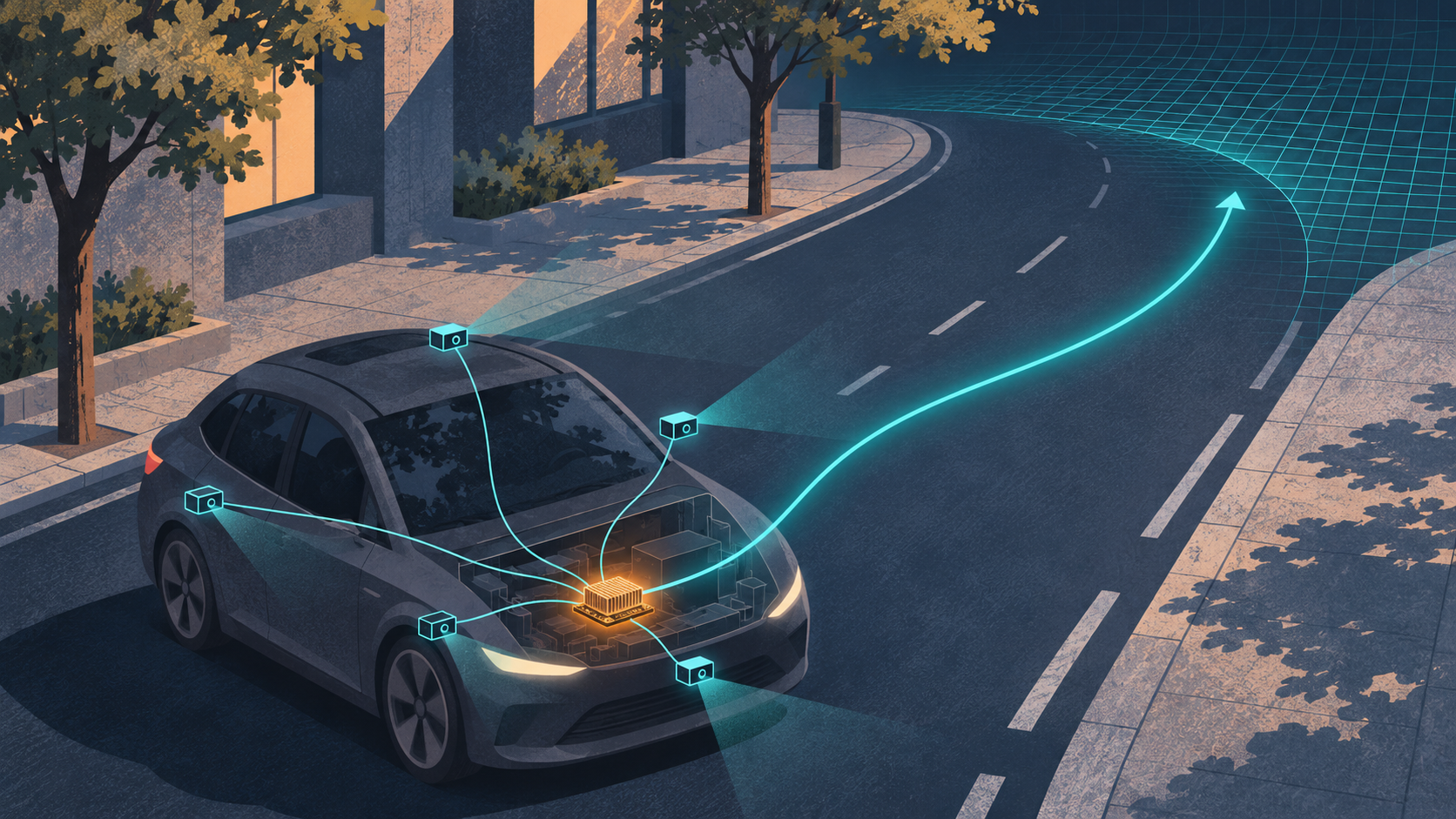
NVIDIA reports that Alpamayo 2 Edge, a 2-billion-parameter vision-language-action model for autonomous driving, can turn camera inputs into planned trajectories in 160–190 milliseconds on DRIVE AGX Thor-X after inference optimization. The November 10, 2026 developer article presents company engineering results and a tutorial; the supplied source establishes no peer-review status.
The model combines a Nemotron-based reasoning backbone with a diffusion model that generates trajectories. It processes surround-camera observations, the vehicle’s motion history and navigation instructions. Adaptive reasoning lets it generate causal explanations when needed and emit a routine-driving token in other cases, reducing text generation and computation. Training includes distillation from Alpamayo 2 Super and closed-loop reinforcement learning in AlpaGym, where the policy learns from the consequences of its actions in simulation.
NVIDIA reports a 48.9% improvement in closed-loop driving performance over its best checkpoint without closed-loop reinforcement learning. However, the article does not define that performance metric or supply absolute scores, evaluation counts or uncertainty. A figure caption also reports approximately 40 times the distance between at-fault incidents in AlpaSim compared with the 4-billion-parameter Qwen-Drive-1.0. Absolute distances, incident counts and driving exposure are absent, limiting interpretation of that comparison.
The reported latency depends on how much reasoning the model generates. The reference configuration used DRIVE OS 7.2.7.0, CUDA 13.4 and TensorRT 11.3.1.9, with FP8 calibration, TensorRT engines and DFlash2 speculative decoding. The deployment recipe compares optimized outputs against a BF16 PyTorch reference using identical inputs and seeded action noise, but the article provides no quantitative quality-retention results or latency distribution. Its example command specifies one warmup and five repeats; those repetitions do not establish the sampling behind the reported range or represent independent driving scenarios. The range also does not establish worst-case response deadlines or latency across the full vehicle system.
NVIDIA also describes AlpaJudge, an evaluator used to score reasoning, select training examples and provide reinforcement-learning rewards. Its reference-based version measures agreement with a supplied answer; its reference-free version uses camera frames and action context to assess an explanation against a learned rubric. One notebook smoke test returned scores of 0.999 and 0.842, respectively, using manually authored rationale and action context. These illustrate software operation, not population-level accuracy or safe driving. The source describes human calibration but gives no validation sample sizes or agreement statistics.
The results outline a route to fitting reasoning-based planning within onboard computing limits, while leaving substantial validation questions open. Evaluation sample sizes, scenario composition, training overlap and scenario independence are unreported. Simulation gains do not establish real-world safety or deployment readiness, and early partner testimonials lack reproducible protocols and uncertainty. Only figure captions and text were available here, so other plotted benchmark values could not be assessed.
Cover illustration generated with AI; conceptual, not research evidence.