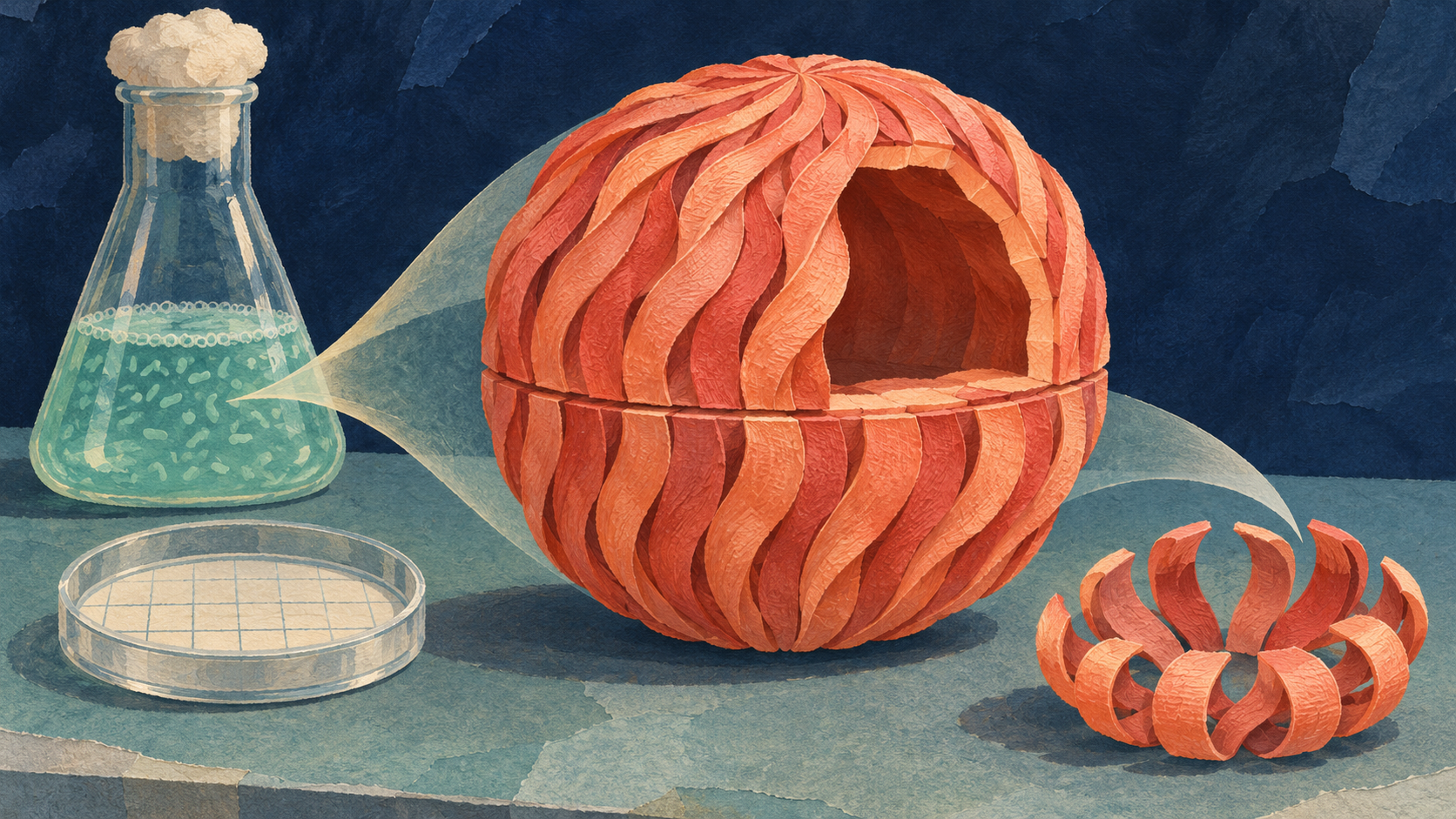
Anthropic reported on November 4, 2026, that proteins related to the major vault protein can assemble into vault-like shells when produced in laboratory-grown E. coli. Its biology team determined the three-dimensional structure of one shell made from a bacteriophage protein called L05. The finding offers a system for investigating these mysterious cellular structures, but does not establish their biological function or show that the particles form in their natural hosts.
Vaults are large, hollow protein assemblies discovered in 1986. They occur widely in eukaryotes, including humans, but proposed roles in transport, protection from toxic compounds and immunity remain unconfirmed. Related protein sequences had already been identified in bacteria and bacteriophages, the viruses that infect them; whether those proteins assembled into vaults was unclear.
The researchers searched approximately 15 billion predicted proteins and reported relatives across 29 bacterial and four archaeal phyla, although in less than 1% of species with sequenced genomes. They screened 44 candidates in a cell-free system and advanced 24 to expression in E. coli. Fifteen produced soluble protein; seven of those formed vault-like particles under electron microscopy. Cryo-electron microscopy, which combines images of rapidly frozen particles into a three-dimensional reconstruction, confirmed vault shapes for four candidates: two bacterial and two phage proteins.
L05, selected because it readily formed complete shells, assembled from 96 protein copies, compared with 78 in mammalian vaults. Its estimated mass was 9.5 megadaltons, and it measured approximately 54 by 45 nanometers, versus 67 by 40 nanometers for mammalian vaults. Although shorter, its rounder shape enclosed about 25% more volume. Tests of 15 altered L05 proteins found that some single changes near the cap produced open, rosette-like particles, supporting a role for those sites in shell closure. Duplicating two repeating wall segments increased enclosed volume by approximately 20% while preserving assembly. These results suggest structural flexibility, but do not demonstrate evolutionary history or practical applications such as enzyme delivery.
Each L05 protein copy also contained a density consistent with a small molecule. Its resemblance to coenzyme A is a hypothesis: neither the molecule's identity nor its significance has been established.
According to Anthropic, Claude assisted with sequence searches, DNA designs, purification and microscopy analysis under human direction. Purification took approximately 90 minutes from cells to microscopy grid, compared with roughly three days for a conventional method used for eukaryotic vaults. A first structural model took 34 hours and final maps about one week. These were not controlled comparisons; the claimed alternative duration of weeks was an author estimate, and processing used hundreds of GPUs in parallel. Reported errors included a protocol problem causing a two-week delay and an initially flawed microscopy map. Changing models, human guidance and computing resources limit attribution of the reported gains to Claude alone.
The supplied article provides no cryo-EM resolution, particle counts, independent replicate counts, uncertainty estimates or detailed structural validation. Selection favored proteins that expressed and assembled successfully, limiting conclusions about how commonly related proteins form vaults. All particles were produced in E. coli; assembly in native bacteria or during natural phage infection remains untested. Anthropic said a preprint had been submitted to bioRxiv and that structures and additional data would follow. The referenced technical report and underlying data were not supplied, and peer review and independent replication are not established.
Cover illustration generated with AI; conceptual, not research evidence.