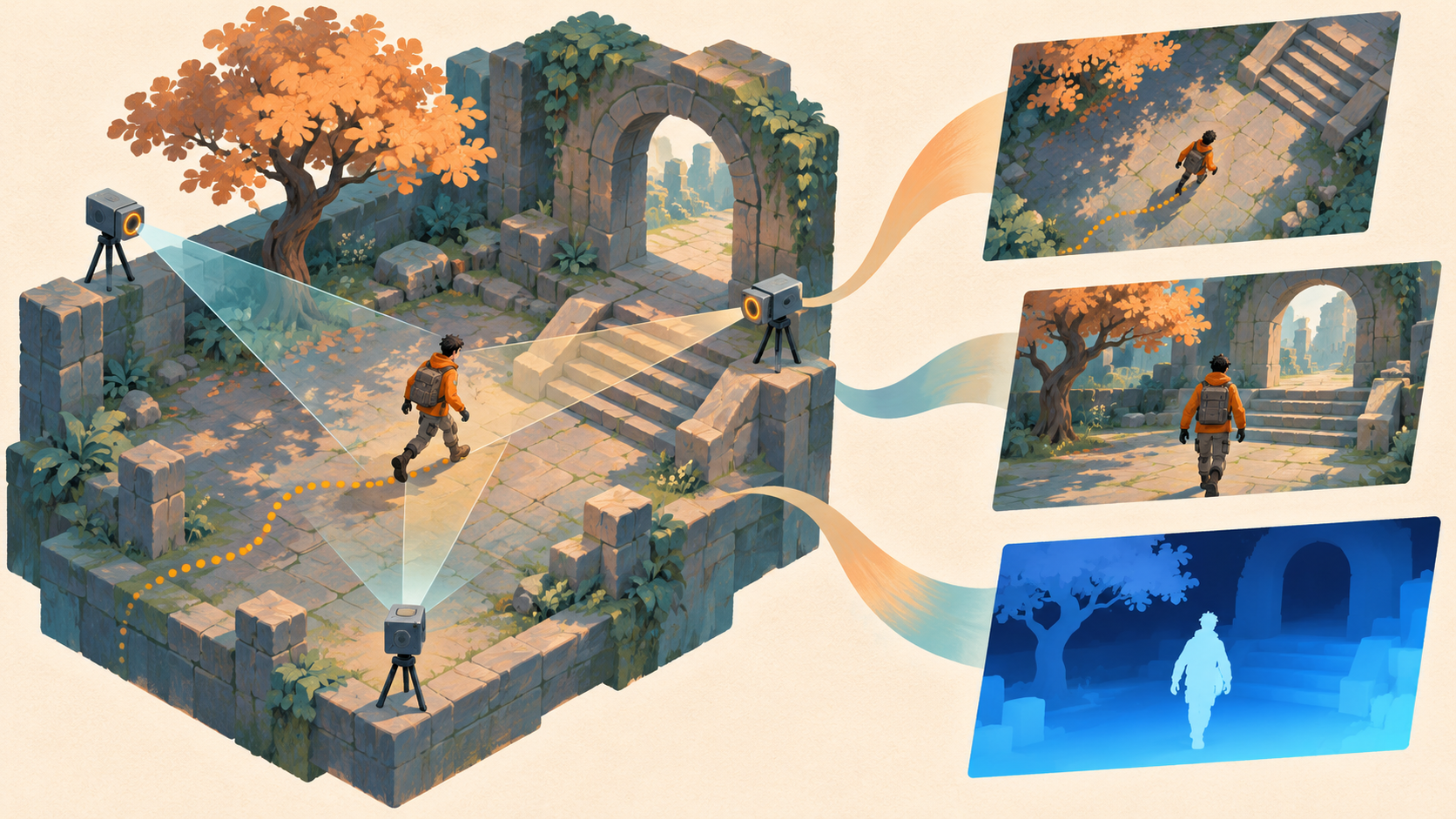
NVIDIA researchers have described Isekai3D SDG, a platform designed to turn one recorded gameplay sequence into multiple sets of synthetic visual training data. Its central approach separates simulating activity from rendering observations, allowing researchers to change camera views, output resolutions and rendering passes without repeating the original simulation. The report was posted to arXiv on November 2, 2026; peer review is not verified.
The demonstrated workflow focuses on third-person gameplay in Unreal Engine. Its assets include more than 500 generated humanoids and more than 245 licensed environments. During simulation, plugins record world state alongside timestamped character movements, camera tracks and input events. A later capture stage replays those records to produce video or images, with optional outputs such as depth, surface properties and instance identifiers. Camera, character and action metadata accompany the visual frames.
That separation supports paired observations of the same activity, including first-person, third-person, top-down and panoramic views. Such data could support research on world models, which represent how environments evolve, as well as vision systems and gameplay agents. However, the report does not test whether data from the platform improves model accuracy, agent performance, robustness or transfer to the real world.
One efficiency feature, called phantom simulation, records several independent character trajectories in a shared world. Characters collide with the environment but do not interact with one another, and each capture shows only the selected character. The authors report approximately 1.3–2× higher end-to-end generation throughput compared with repeating simulation across trajectories, depending on the machine and workload. These characters therefore do not provide interacting multi-character scenarios, and views derived from shared recordings are related observations rather than independent gameplay samples.
The platform also supports lazy datasets: training clips are read and transformed on demand from stored video and metadata. In one measured workflow, constructing such a dataset over 10,000 hours of video took 3 minutes in Python, while copying the same footage without processing took 16 hours using a tuned utility. These operations do different work. Reading and transforming samples still costs time during training, so the comparison does not establish equivalent savings for a complete training run.
A packaged application allows generation without installing the Unreal Engine editor, while plugins and compatible dynamic-link libraries provide ways to extend functionality. The report nevertheless remains primarily a system description. Hardware specifications, workload composition, repeated-run counts and uncertainty are absent from the performance measurements. It also provides no quantitative checks of replay fidelity or metadata alignment, no measured assessment of asset coverage, and no independent validation. The supported contribution is a configurable data-generation workflow; its downstream learning benefits remain to be demonstrated.
Cover illustration generated with AI; conceptual, not research evidence.