Writing image coordinates into an AI model’s reasoning can improve counting without delivering broad improvements in visual understanding, according to a preprint posted to arXiv on November 5, 2026. David Yan and colleagues, primarily affiliated with Elorian, with a Princeton affiliation also listed, examined when this technique helps vision-language models. Peer review has not been verified.
The study concerns coordinate-only grounded reasoning: models write locations as text while working through an image-based problem. It does not test approaches that repeatedly crop or reprocess images. The researchers compared grounded and natural-language reasoning using Qwen3-VL-8B, a supervised training dataset of 6,368 examples and subsequent reinforcement learning. Evaluation covered six spatial reasoning, three perception and two counting benchmarks. Most training conditions used three independently trained checkpoints; counting answers used greedy decoding.
After supervised fine-tuning, grounded reasoning reached 32.7% on CountQA, versus 29.1% for the ungrounded comparison, across 1,528 questions. The reported gain was 3.6 percentage points, with a 95% confidence interval of ±2.4 points. On FSC-147’s 1,190 questions, scores were 10.3% versus 7.7%, a gain of 2.6 points, ±1.3. Neither training stage produced a significant positive gain on any of the nine spatial or perception benchmarks under the authors’ interval criterion. After reinforcement learning, grounded models performed significantly worse on three spatial benchmarks.
To test whether models depended on their written coordinates, the team replaced coordinates with random values during generation and reset the model’s cached state before continuing. They sampled 20 completions per question. Existing open models’ spatial and perception accuracy generally changed by less than one percentage point, while some counting results deteriorated more. This measures sensitivity to emitted coordinates; it does not establish how a model reasons internally.
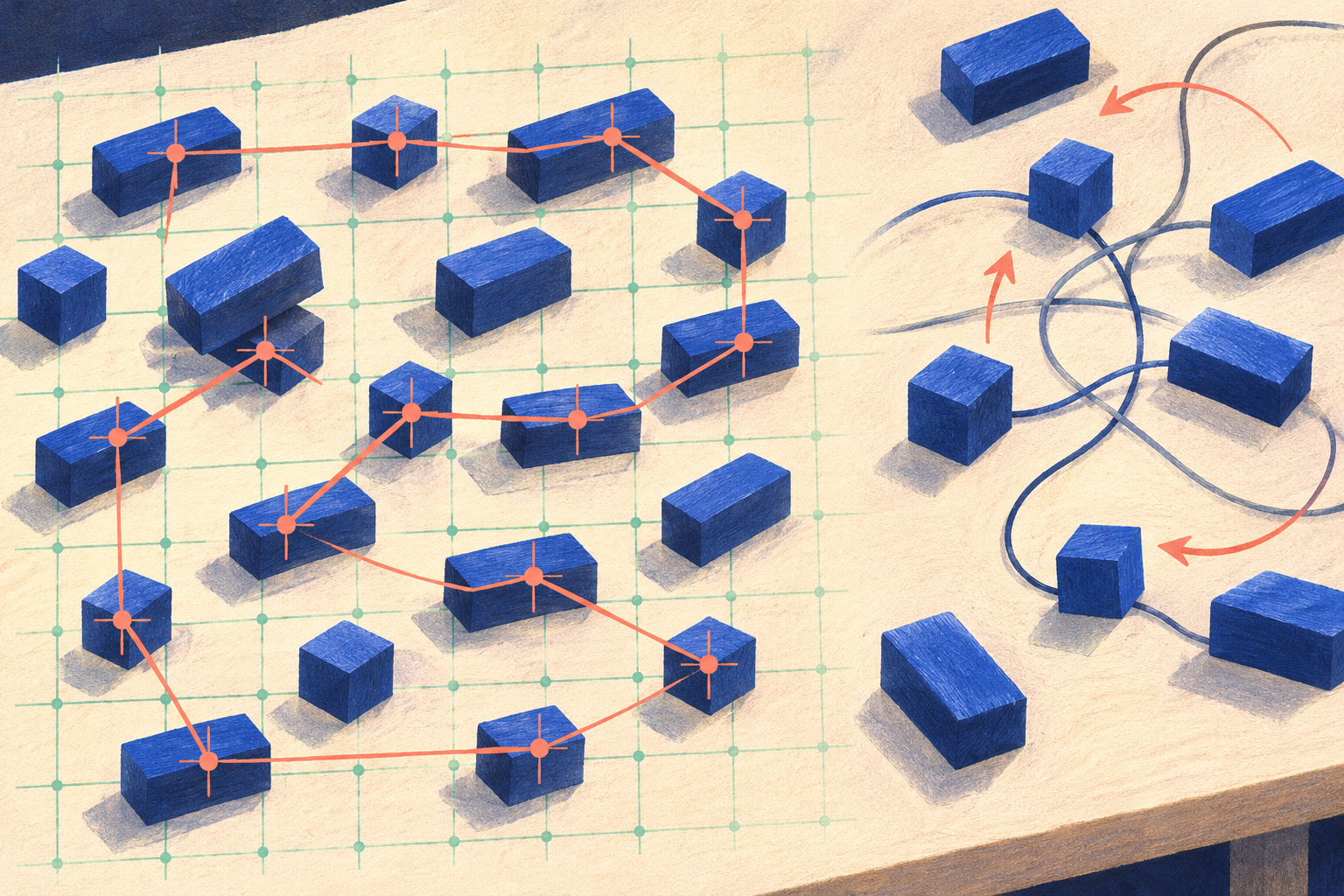
Synthetic wire-tracing, counting and arrow-following experiments offered a possible explanation. On wire tracing without intermediate text labels, coordinate reasoning scored 69.3%, compared with 24.4% for text reasoning. Adding labels made text reasoning outperform coordinate reasoning on all three task types. The authors interpret this as evidence that coordinates help maintain references to objects or locations that are difficult to describe uniquely in words.
The team also introduced BrickVision: 1,000 questions, split equally among crop identification, fine-grained counting, duplicate identification and unpaired identification. On this benchmark, task-specific fine-tuning of Qwen3.5-9B yielded 82.9% with coordinates versus 61.2% with text reasoning. Separately evaluated GPT-6 Astra scored 68.7%. These are different training settings, so the scores do not establish like-for-like superiority.
The findings remain limited to selected models, tasks and coordinate-based methods. Each synthetic training variant was trained once, limiting assessment of variability. BrickVision uses procedurally generated scenes restyled by an image model; residual misalignment with original scoring labels could affect results, and its frequency is not reported. Nonsignificant differences do not prove equivalence, and no independent replication is supplied.
Cover illustration generated with AI; conceptual, not research evidence.