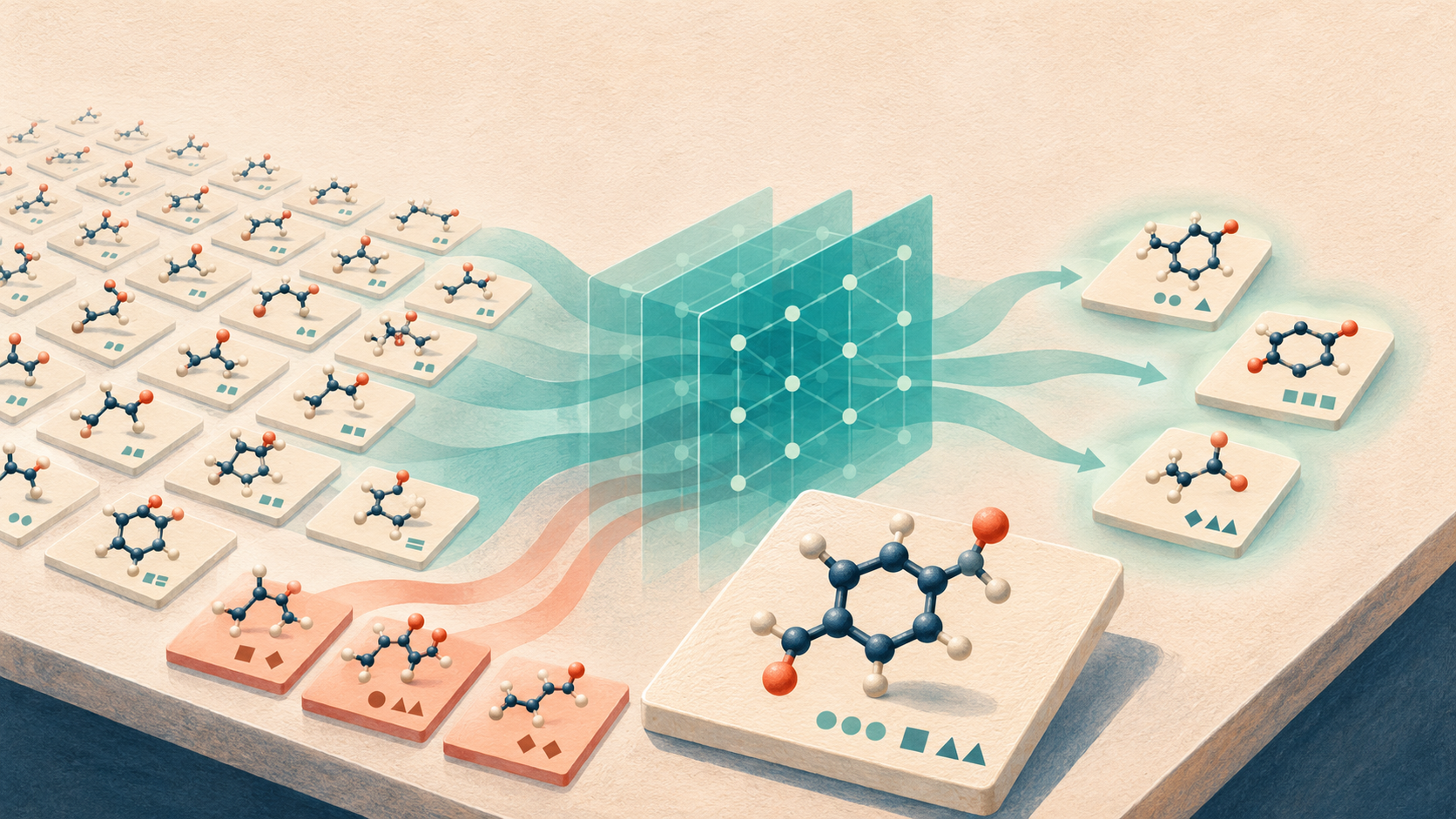
A molecular prediction model developed at MIT could help researchers prioritize compounds for testing when experimental data are scarce. Called CheMeleon, it first learns from inexpensive, calculated descriptions of molecular structure, then adapts to specific prediction tasks using limited labeled data. The evidence concerns computational prediction; it does not demonstrate successful development of a new drug.
In its November 6, 2026 report, MIT describes research by Akshat Shirish Zalte, Jackson Burns, Charlles Abreu, William Green and three BASF researchers. According to the report, their paper, “Deep learning foundation models for low-data regimes from classical molecular descriptors,” appeared in the September 14 issue of the Journal of Chemical Information and Modeling following peer review. The paper and review materials were not supplied for direct assessment.
Built using the open-source ChemProp package, CheMeleon was pretrained on approximately one million molecules from PubChem, the chemical information database maintained by the U.S. National Institutes of Health. Its training task was to predict about 1,600 computed molecular descriptors, including molecular weight and oxygen counts. Researchers then fine-tune the model for individual properties, such as solubility or biological activity. This transfers patterns learned during pretraining instead of requiring each task to be learned from scratch.
The researchers compared CheMeleon with other molecular foundation models and classical models using expert-designed descriptors across 58 test cases. They report the best overall performance for CheMeleon. Molecules were the prediction units, while the 58 cases represented task-level evaluations. The supplied account provides no numerical scores, effect sizes, uncertainty estimates or task-specific results, so the size and consistency of the advantage cannot be assessed.
MIT also reports that nine of the top 20 entries in an OpenADMET competition used CheMeleon within their workflows. That shows uptake among highly ranked entries, but does not separate the model’s contribution from other workflow components. Pharmaceutical company adoption is described through researcher statements, rather than independent validation. The model is available through ChemProp for download and fine-tuning.
The practical promise is to guide which molecules deserve costly synthesis and testing, but the supplied evidence does not quantify experimental measurements or costs saved. Benchmark identities, dataset sizes, evaluation metrics, comparator settings and data-splitting procedures are missing. Without the underlying methods, overlap between pretraining and test data, dependence among related molecules, leakage, tuning and repeated comparisons cannot be assessed. The reported benchmarks therefore support further investigation of prediction with limited data, rather than establishing universal superiority or prospective drug-discovery success.
Cover illustration generated with AI; conceptual, not research evidence.