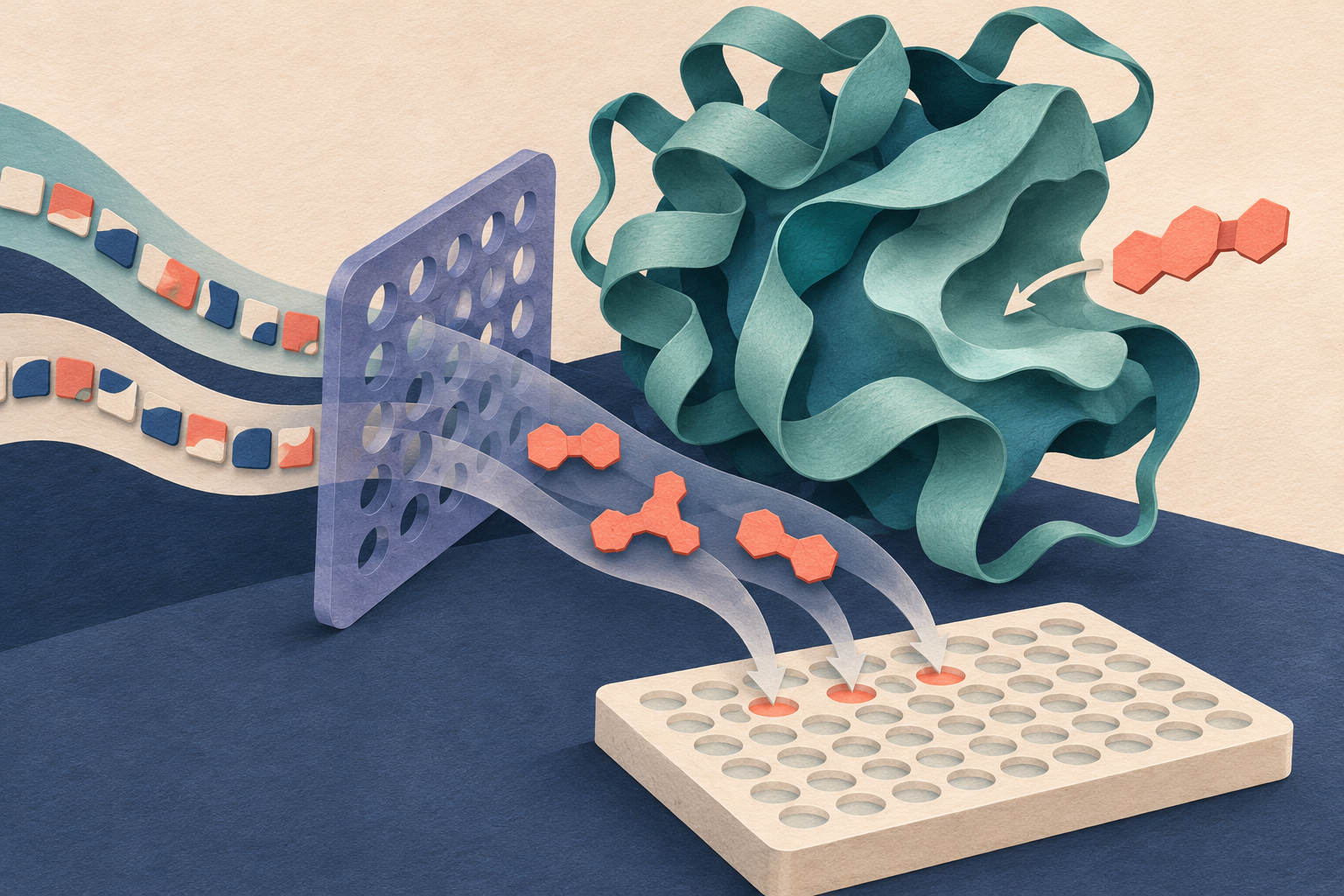
Output Labs reports that its Bonbon molecular-interaction model can identify functional effects, binding locations and covalent engagement from paired protein–ligand sequences, with selected compounds showing biochemical activity across nine disease targets. The findings appear in an arXiv preprint by Adi Mashiach, posted November 10, 2026. Peer review is not verified, and independent replication is not supplied.
Bonbon’s largest version has 1.6 billion parameters and was trained on approximately 3.2 trillion tokens from proprietary screening data and synthetic interactions, without structural coordinates or task-specific pretraining labels. Researchers evaluated its frozen representations using feature-based scoring rules. Although the paper calls these capabilities zero-shot, feature signatures were identified from representations and held fixed across scales; the supplied material does not fully establish how signature discovery was separated from evaluation labels.
Across six model sizes, from 42 million to 1.6 billion parameters, the largest model showed a sharp final-step improvement while pretraining loss fell smoothly. Between 1.3 billion and 1.6 billion parameters, mechanism-of-action macro precision rose from 0.608 to 0.811, orthosteric/allosteric AUROC from 0.602 to 0.834, and covalent-engagement AUROC among molecules without detectable reactive warheads from 0.645 to 0.775. These results document a jump in this experiment, rather than establish a universal emergence threshold: each size had one training run, and both parameter count and training-token budget changed.
The mechanism-of-action evaluation covered 107,027 interactions across six classes and reported 81.1% macro precision, an equal-weight average of precision across classes. A separate test distinguishing agonists from antagonists acting on the same receptors reached 85.5% balanced accuracy across 222 GPCRs. Binding-site localization had a reported out-of-distribution F1 score of 0.388 ± 0.124, although the supplied passage does not define the uncertainty term.
For distinguishing the primary, orthosteric binding site from secondary, allosteric sites, Bonbon achieved AUROC 0.834 on 6,032 out-of-distribution complexes, versus 0.589 for molecular fingerprints. Covalent-engagement classification reached AUROC 0.838 on 1,212 out-of-distribution pairs. AUROC measures ranking discrimination, not the percentage of predictions that are correct. The study’s protein exclusion rule removed training proteins with greater than 90% sequence identity to evaluation targets, leaving possible relatives below that threshold.
On binding-prediction benchmarks, the paper reports an enrichment factor at the top 1% of 16.6 on LIT-PCBA-AF3, versus 9.3 for its strongest reported co-folding comparator. Affinity prediction used a separately supervised probe on frozen representations, reaching Pearson correlations of 0.74 on CASP16 and 0.78 on FEP+4. Reported throughput on one H100 was approximately 2,500 pairs per second, or 42,500 with cached representations. Speed comparisons depend on workload and caching, and sequence scoring produces different outputs from three-dimensional structure prediction.
For prospective laboratory testing, researchers ranked newly generated, synthetically accessible molecules and synthesized up to 24 per target across nine targets spanning seven protein families. They report a 61.5% dose-response hit rate and confirmed inhibitors for every target, including JAK1 activity down to an IC50 of 3 nM and VEGFR2 activity down to 38 nM. VEGFR2 and ELANE were designated out-of-distribution targets. These measurements support biochemical inhibition under the reported assay conditions; they do not establish selectivity, cellular activity, safety or therapeutic benefit.
Key validation details remain unavailable in the supplied material, including the overall tested-compound denominator, hit threshold, replicate counts and full assay protocols. No matched competing-method or random-selection arm was reported, so the laboratory results cannot quantify how much Bonbon improved discovery yield. Unreleased weights and training data, an undisclosed synthetic-data method and incomplete information about dependence among observations also limit reproducibility and confidence in broader claims.
Cover illustration generated with AI; conceptual, not research evidence.