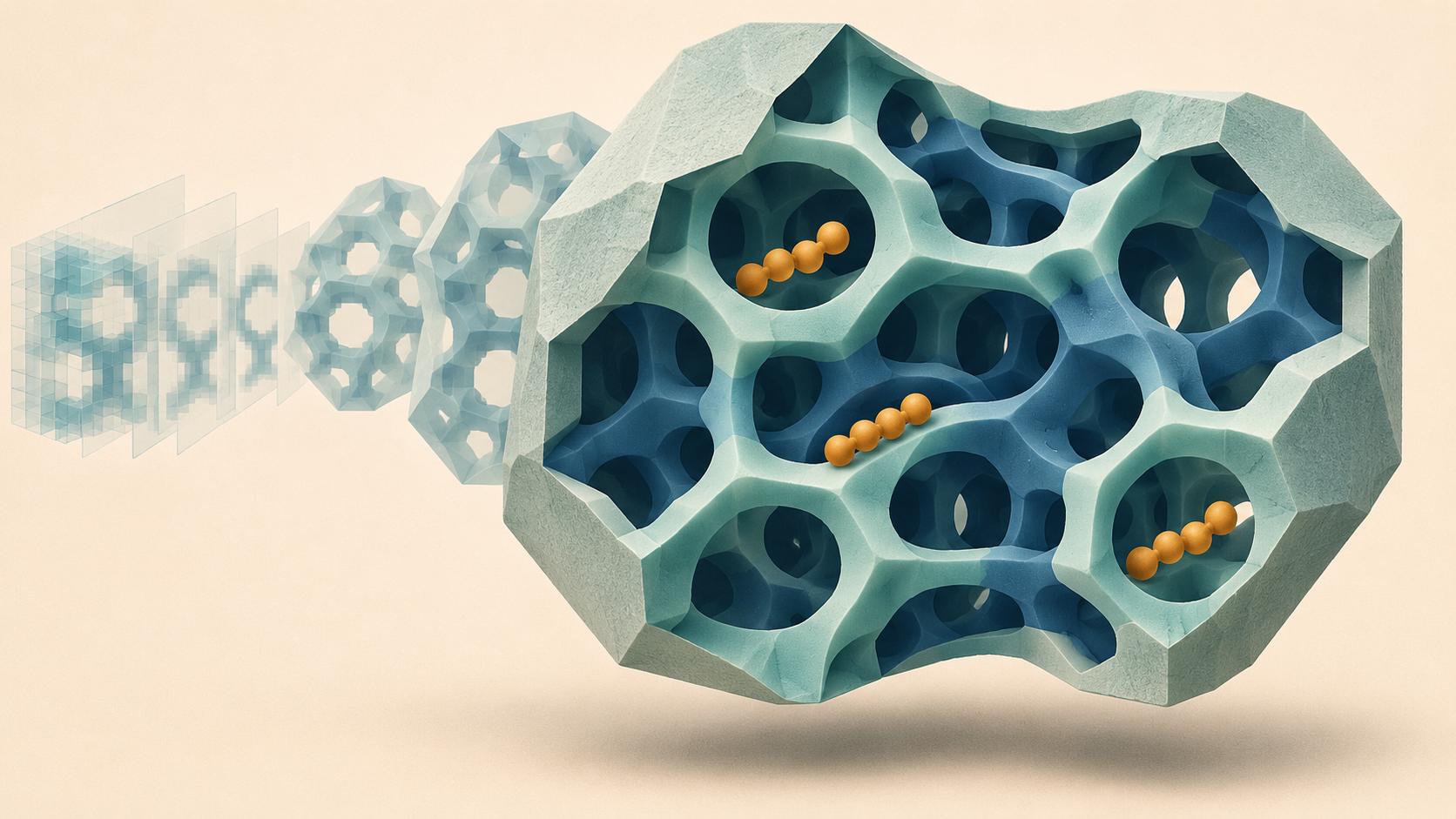
Learning the shapes of porous crystals before training on adsorption labels can improve prediction accuracy, researchers at the University of Massachusetts Amherst report in ZeoBench. Their arXiv preprint, posted November 6, 2026, evaluates self-supervised learning for all-silica zeolites. Peer review has not been verified, and the findings are author-reported without independent replication supplied.
Zeolites have applications in separations, gas storage and catalysis. Their pores influence which molecules they adsorb, but generating property labels through simulations is computationally expensive. ZeoBench tests whether models can first learn useful geometric features from a large unlabeled collection, then adapt to adsorption tasks with fewer labeled structures.
The corpus contains 402 experimentally synthesized and 331,172 hypothetical structures. The authors describe approximately 301,000 structures for pretraining, 20,000 for validation and 10,000 for testing, with validation and test structures excluded from training throughout. Structures are represented as 64 × 64 × 64 signed distance grids encoding distance to the framework surface. Four self-supervised objectives—BYOL, DINOv1, MoCov2+ and SimCLR—were compared using a common 3D ResNet-18 backbone, with translation, rotation and scale augmentations.
Evaluation covered six hydrocarbons: the linear alkanes C18, C24 and C30, plus three branched C18 isomers. Models predicted simulation-derived log Henry’s constants, a measure related to adsorption strength, generally using 100–10,000 labeled structures per task. Researchers either froze the learned features and trained a linear predictor or fine-tuned the network. The metric was test mean-squared error, or MSE; lower values indicate better predictions.
With 10,000 labels per task, SimCLR fine-tuning achieved an average MSE of 11.8 ± 0.4 across the six tasks, compared with 13.5 ± 0.5 for the same ResNet trained from scratch—approximately 12.6% lower MSE. With the full approximately 70,000-label C18 training set, MoCo scored 3.1 ± 0.2 against ZeoNet’s 3.7 ± 0.2, approximately 16.2% lower MSE. These percentages describe prediction-error reductions, not increases in adsorption capacity.
For frozen features with 10,000 labels per task, MoCo averaged 27.4 ± 0.8 MSE and SimCLR 28.5 ± 0.8, versus 48.7 ± 1.1 for adapted ImageNet features, 56.9 ± 1.7 for handcrafted descriptors and 60.8 ± 1.2 for medical-volume pretraining. Scale augmentation helped representation learning. Tested ResNets also outperformed tested ViT and Swin models, although this does not establish universal architectural superiority. An exploratory transfer experiment on metal–organic frameworks also reported benefits from zeolite pretraining.
The evidence remains bounded by simulation labels, fixed-composition frameworks and six hydrocarbon targets with positive Henry’s constants. It demonstrates neither successful synthesis nor improved experimental adsorption or industrial performance. Uncertainty was estimated through 1,000 bootstrap trials over test examples, but the supplied text does not specify what the ± intervals represent or establish variability across independent training runs. Tasks share structures and label subsets are nested, so their outcomes are not independent confirmations. Whether closely related framework families cross the fixed splits is unreported; numerous comparisons also lack a supplied multiplicity analysis. Detailed appendices are unavailable in the supplied text. ZeoBench therefore offers a promising benchmark for prediction with limited labels, while broader chemical and practical generalization remains unresolved.
Cover illustration generated with AI; conceptual, not research evidence.