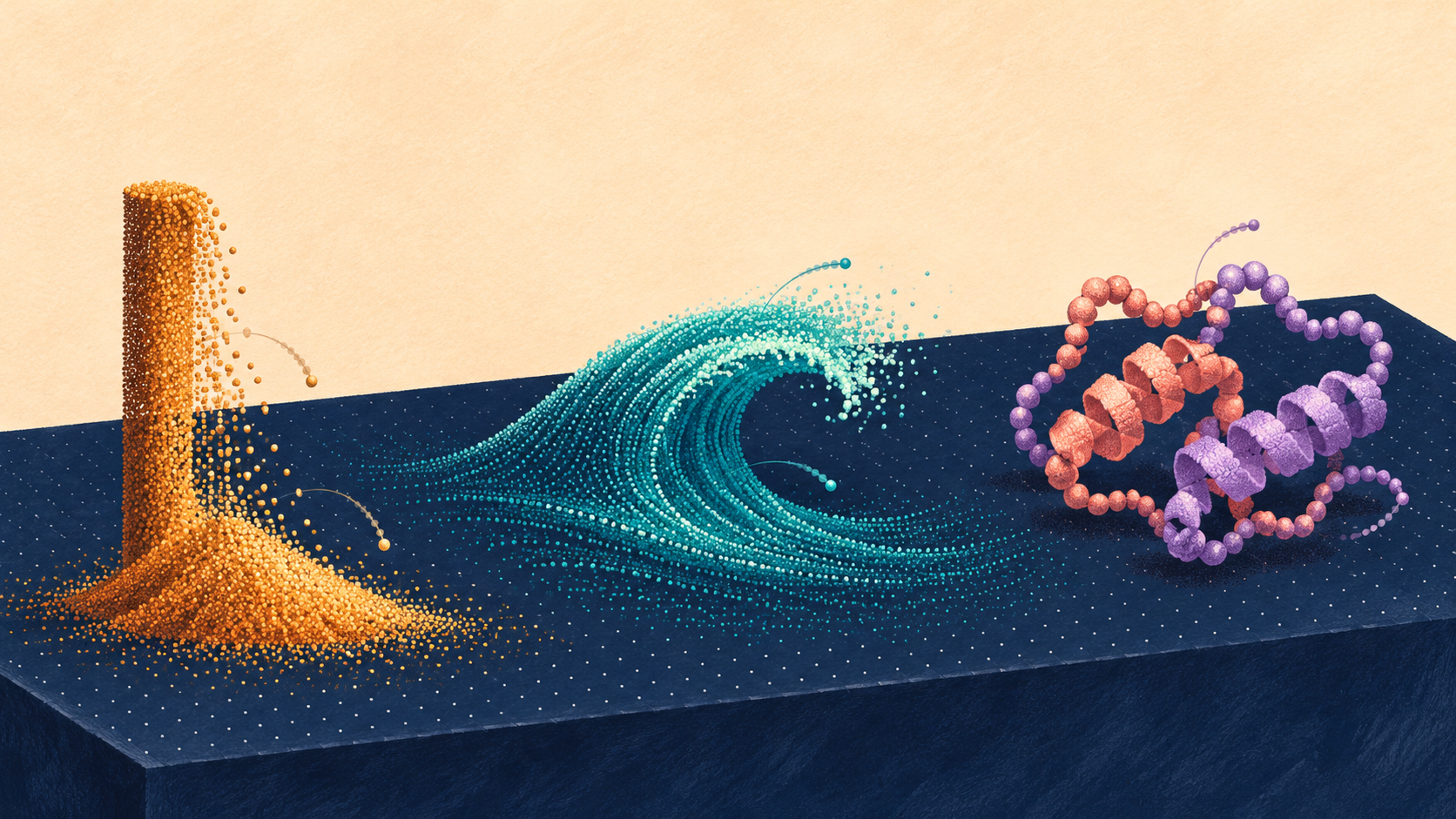
Researchers at MIT, the University of British Columbia and other institutions have developed WorldParticle, an AI system intended to simulate several kinds of matter through a shared architecture. According to a November 9, 2026 report from MIT News, the team evaluated it on six physical phenomena, including deformable objects, granular materials and proteins.
Physical simulation commonly relies on specialized numerical solvers built around equations for a particular material or process. WorldParticle instead represents a system as three-dimensional particles using a Lagrangian representation, which follows particles as they move. A transformer neural network uses particle positions and physical properties to predict successive states, building a simulation step by step.
The system handles external forces separately before incorporating their effects into its predictions. It also merges particles to compress the representation and reduce computation. These design choices aim to support different physical conditions and larger simulations within one framework.
MIT News reports higher accuracy across the six phenomena than numerical simulation methods, but supplies no numerical error measurements or named comparators. In one example, simulated granular material collapsed into a pile, while some baseline methods reportedly left particles suspended in the air. Minghao Guo, an MIT postdoc and study co-lead author, also reported protein-dynamics simulations about 100 times faster than numerical simulators. The coverage does not specify absolute runtimes, hardware, system sizes or whether that speed comparison used matched accuracy.
The evidence available here is institutional news coverage; the original paper and benchmark tables were not supplied. Dataset sizes, training and test splits, possible overlap between training and evaluation systems, repeated runs and statistical uncertainty are unspecified. Particles and successive simulation frames cannot be treated as independent evaluation samples. Quantitative evidence for generalization to unseen materials, forces and environments is also absent from the supplied account. Long-term stability, conservation of physical quantities, scaling costs and independent replication remain unestablished.
Potential applications include interactions between fluids and deformable solids, soft robots working with soil, and molecular research. RNA evolution and galaxy mergers are further directions proposed by the researchers, rather than demonstrated applications. The results do not establish a universal simulator or proven benefits for medicine or robotics.
MIT News identifies the paper as “WorldParticle: Unified World Simulation of Lagrangian Particle Dynamics via Transformer” and says it will be presented at ACM SIGGRAPH Asia. The supplied material does not explicitly establish its peer-review status.
Cover illustration generated with AI; conceptual, not research evidence.