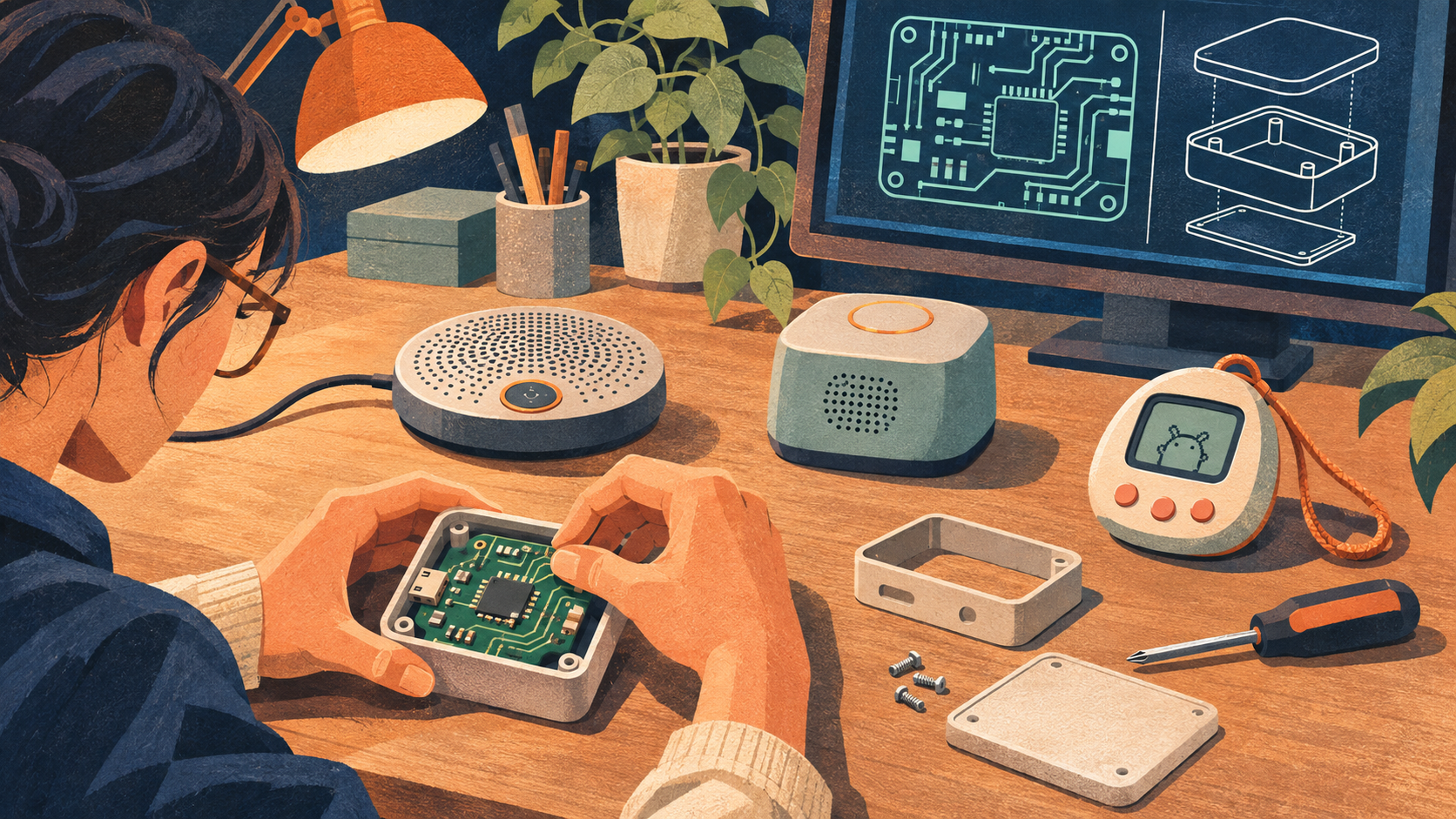
Anthropic reported on November 9, 2026, that Claude Fable 5.2 designed a USB speakerphone, a voice-assistant hub and a handheld virtual pet that worked without fixes to their circuitry after assembly. The work, conducted with Diode Computers, demonstrates a workflow spanning electronics, physical design and firmware. Human engineers manufactured, assembled and tested the devices.
Each project began with brief hardware requirements. According to Anthropic, Claude produced specifications, circuit schematics, printed circuit board layouts, enclosure models, firmware and parts lists. It consulted component documentation, revised its designs and checked manufacturing constraints and parts availability. Diode reportedly manufactured all three boards directly from the design files without requesting manufacturing adjustments. All three prototypes remained operational at reporting, with the speakerphone used for weeks.
The examples illustrate how design decisions crossed several engineering disciplines. For the speakerphone, Claude reassigned chip pins to keep connections beneath touch controls on a single copper layer. It also checked enclosure fit and identified an assembly procedure requiring the board to tilt about 25 degrees. For the voice-assistant hub, it wrote a routing algorithm to connect components and adjusted spacing around sensitive signals. These examples support feasibility in the demonstrated projects; they do not measure a general success rate or establish how much engineering time the system saves.
Separate benchmark results suggest improved geometric-design performance. On Diode’s internal PCB Gym, which asks models to place components and route connections on boards whose layouts have been removed, Fable 5.2 scored 69%, versus 25% for Fable 5: a 44-percentage-point increase. On public BenchCAD 2.1, which tests reconstruction of parts, assemblies and boards from drawings and rendered images, it scored 83.5%. Anthropic described that as nearly double Fable 5.1’s score but supplied no exact predecessor score.
Those comparisons have important limits. The account does not supply benchmark task counts, detailed scoring definitions, uncertainty estimates, repeated-run results, matched resource budgets or safeguards against prior exposure to evaluation material. A public benchmark also does not establish that this evaluation was independently conducted.
The hardware evidence is similarly limited to three reported projects. Total attempts, failures, selection criteria and standardized functional acceptance tests are unspecified. Engineers supplied occasional short prompts as well as physical construction and testing; their effort and intervention were not quantified. The devices had not undergone electrical validation, antenna tuning, thermal testing or certification, and were not designed for mass production. Long-term durability and commercial readiness remain unknown.
The source is a company research post, with peer review not established. Anthropic and Diode have a commercial relationship, and the account does not establish independent replication. The reported outcome is therefore a promising prototype demonstration, with broader reliability still to be tested.
Cover illustration generated with AI; conceptual, not research evidence.